Globus Compute - Remote User Functions
Globus Compute (formerly funcX) is a distributed, high-performance function-as-a-service platform. When libEnsemble is running on a resource with internet access (laptops, login nodes, other servers, etc.), it can offload simulator calls to remote Globus Compute endpoints:
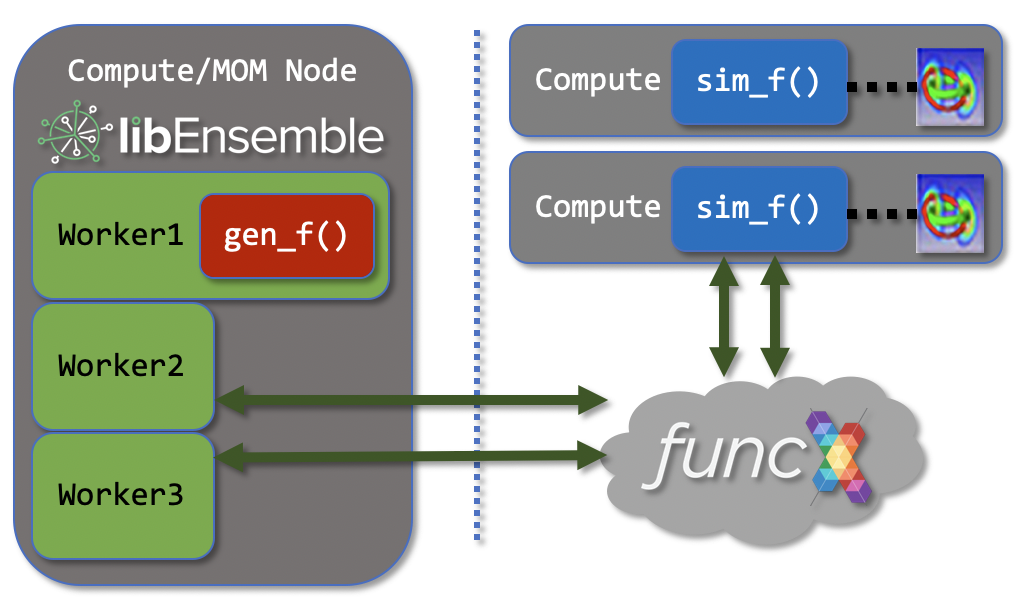
This is useful for running ensembles across machines and heterogeneous resources. There are two approaches, described below.
Caveats
The following caveats apply to all Globus Compute modes:
1. Simulator functions submitted to Globus Compute must be non-persistent, since manager-worker communicators cannot be serialized or used by a remote resource.
2.
Executor.manager_poll()is not available inside remotely executed functions. Control over remote work is limited to inspecting return values and exceptions when tasks complete.3. Globus Compute imposes a handful of task-rate and data limits on submitted functions.
4. Users are responsible for authenticating via Globus and maintaining their Globus Compute endpoints on their target systems.
Manager-side GC (GC-only mode)
The recommended approach for most use cases. When
globus_compute_endpoint is set in SimSpecs
and gen_on_worker is not set (the default), libEnsemble enters
GC-only mode: no local worker processes are launched. The manager
submits simulation work directly to Globus Compute and polls futures for
results. The generator still runs as a local thread on the manager.
nworkers controls the maximum number of simultaneously in-flight
Globus Compute tasks (virtual concurrency). The default is 1.
This mode supports both the gest-api simulator format
(SimSpecs.simulator) and the legacy sim_f format.
from libensemble import Ensemble
from libensemble.specs import GenSpecs, LibeSpecs, SimSpecs


def my_sim(input_dict: dict, **kwargs) -> dict:
    """gest-api simulator - runs remotely on the GC endpoint."""
    return {"f": input_dict["x"] ** 2}


sim_specs = SimSpecs(
    simulator=my_sim,
    vocs=vocs,
    globus_compute_endpoint="3af6dc24-3f27-4c49-8d11-e301ade15353",
)

libE_specs = LibeSpecs(nworkers=4)  # up to 4 concurrent GC tasks

workflow = Ensemble(
    sim_specs=sim_specs,
    gen_specs=gen_specs,
    libE_specs=libE_specs,
)
H, _, _ = workflow.run(sim_max=20)
Users can also define Executor instances within their remote simulator
functions and submit MPI applications normally, as long as libEnsemble and
the target application are accessible on the remote system:
# Within the remote simulator function
from libensemble.executors import MPIExecutor
exctr = MPIExecutor()
exctr.register_app(full_path="/home/user/forces.x", app_name="forces")
task = exctr.submit(app_name="forces", num_procs=64)
Note
Both the simulator callable and any VOCS object must be picklable, as they are serialized and shipped to the remote Globus Compute endpoint.
GlobusComputeExecutor (user-facing)
For workflows where the simulation function itself orchestrates remote
calls, like fanning out to multiple endpoints or mixing local
and remote work. Use the
GlobusComputeExecutor
directly inside the simulator.
Create and register the executor in the top-level script:
from libensemble.executors import GlobusComputeExecutor

exctr = GlobusComputeExecutor(endpoint_id="3af6dc24-3f27-4c49-8d11-e301ade15353")
Then use it inside the simulator function:
import time


def my_sim(H, persis_info, sim_specs, libE_info):
    exctr = libE_info["executor"]

    task = exctr.submit(func=my_remote_func, app_args=H["x"][0])

    while not task.finished:
        task.poll()
        if exctr.manager_kill_received():
            task.kill()
            break
        time.sleep(0.1)

    return H_o, persis_info
See the GlobusComputeExecutor API reference for
the full interface including register_app, submit, and
GlobusComputeTask methods.